

1. General Terms
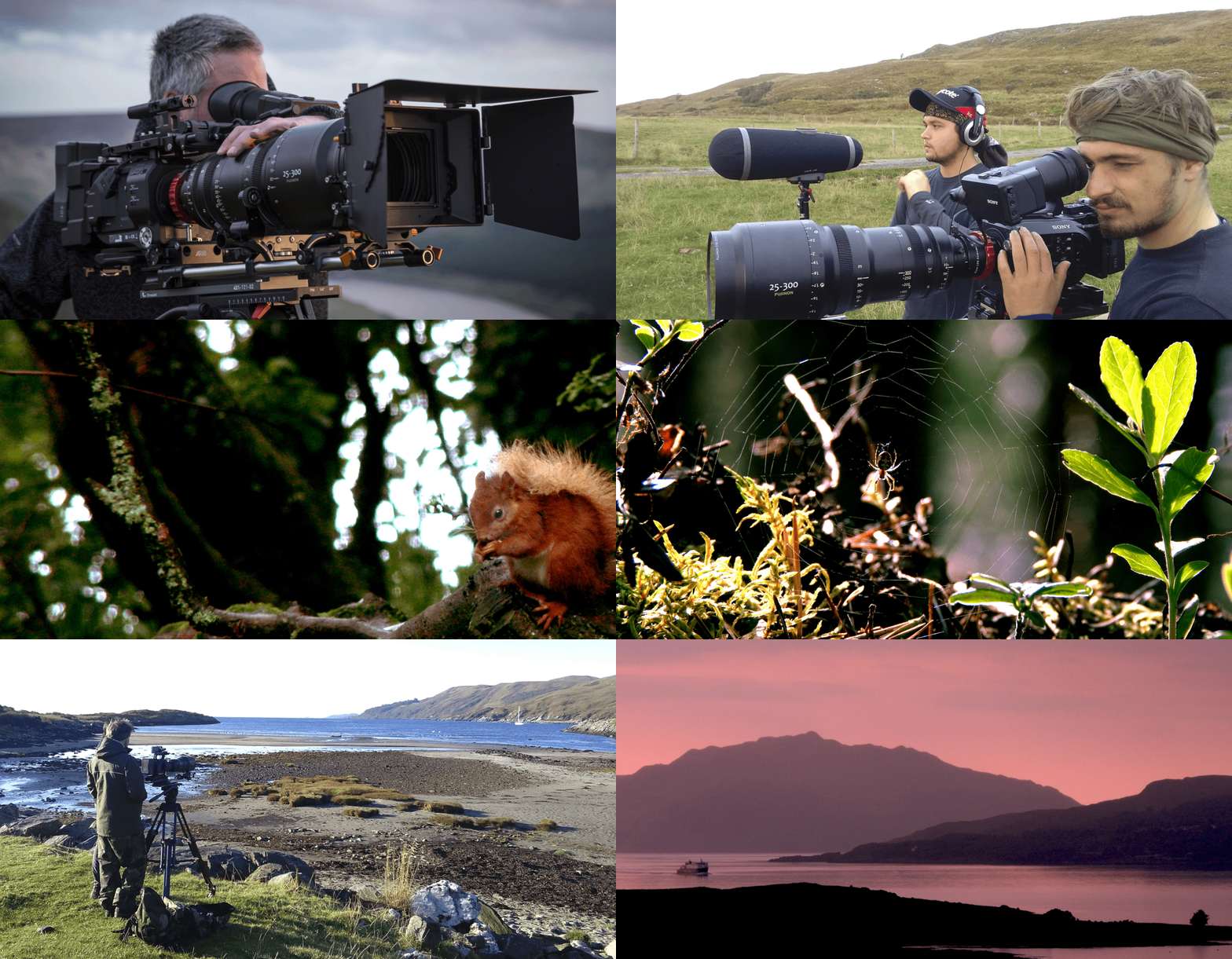
Our wildlife film courses are based around demonstrating to participants the fundamental basics of logistical problems, navigation, camp-craft and camera operation skills you may need to become a professional wildlife camera operator (and production/support crew) whilst out on location.
These are practical/logistically focused courses. Naturally there will be a large element of the course spent filming wildlife; however, you must realise that to gain as much experience as you can from each course, you must in turn be willing to partake in all logistical requests made of you when required.
You must also be aware that filming wildlife requires a massive amount of patience – you may find yourself sitting in one location for long periods of time waiting for the wildlife to appear. This may seem very frustrating at the time, but this actually constitutes a very large part of filming wildlife. When the wildlife does appear and you get the footage that you wanted, you will realise it was all worth the time and patience.
Unfortunately, due to limitations imposed by our insurance cover, you need to be 18 years of age or over to attend one of our wildlife film courses
PLEASE NOTE: When attending any of our courses, you hereby agree that –
• A short write-up about yourself and a testimonial may be added to our Previous Courses / Testimonials Page on our website.
• Any footage filmed/photographs taken of you during the course may be used on our website, as may any footage filmed by you on our film courses.
• Any/all of this information may be used for the promotion of the Wildlife Film School / Wildlife Film Network and any of its courses or events, via any type of media, in any manner in which it sees fit.
2. Abilities and Fitness
One of the areas we would like to focus on is giving people with very little or no experience in the great outdoors the ability to join us and have a go. Our courses are not limited by your previous experience. Broadening your horizons is an essential part of wildlife film making and it is our aim to increase your ability and confidence during every one of our courses.
Equally, this is not to say that our courses are only for beginners, or that they are merely ‘taster’ courses. Our courses have catered to students of any ability and experience, from a first time amateur operator to those who already have decades of experience work in the TV or film industry.
You will however need to be of a reasonable standard of fitness to attend one of our courses. We are not asking you to be super fit (and we will not be asking you to do anything you are not capable of doing) but there may be a large element of walking and carrying equipment in a backpack during your course and you need to be able and prepared to do this.
You will be living in the wild in a tent for the duration of your course. This means that during the first and last day of the course you may be carrying everything required for base-camp to or from the road. This equipment will consist of personal clothing, personal camp equipment, group camp equipment, film and production equipment, food and water.
Please feel free to contact us if you would like to discuss any matters with reference to any practical experience you may or may not have, or the physical requirements of any of our courses. [ Contact Us ]
3. Locations
Living and working in the field means that some of the everyday luxuries you may be used to at home or in the office will not be there. However (new for 2027) over the last twelve plus months, we have been building a ‘custom built basecamp trailer with a mobile edit suite inside it’ specifically for use during our wildlife film courses.
The Mobile edit suite is based in a trailer that is towed by our Land Rover. This means that not only are we able to relocate it to different areas during the course, but we are also able to leave the trailer in basecamp whilst we drive off to a more remote filming location.
Some of the facilities in our new basecamp trailer / edit suite are –
The edit suite –
Our IMac Pro and MacBook Pro both run Adobe Premier CC (as over the years we have learnt that this is the most commonly used editing software by our students, so therefore it is only sensible for us to use also it) For students wanting to use other editing software, we also have Final Cut Pro and DaVinci Resolve. The edit suite runs of a bank of thunderbolt hard drives, offering 36 terabytes of 4k storage for your project. We also have several LaCie ‘Rugged’ Hard Drives for downloading footage in the field, rack mounted audio play/recorder/editing/distortion units as well as DV, DVcam and HDV video decks.
Our Land Rover is also fitted with a 1000w inverter running into an internal mains ring. This allows us to run the laptop in the Land Rover when digitising footage, watching rushes or editing whilst out on location; and be able to charge camera batteries and other devices etc.
Air conditioning –
After the recent months of extremely hot weather in the UK, we have added a little bit of extra luxury to our edit suite, by installing an air conditioning unit. You may feel that the weather in Scotland does not rate such an investment; however when we were last in the Shetland Islands the average daily temperature was 28c for the whole time we were there. So being able to efficiently cool the edit suite is really nice.
Solar electricity –
We will not be plugged into the mains. However, we do have two separate solar powered electrical systems in our basecamp trailer. The smaller system runs the trailer, lighting, cooling fans, fridge etc. with the larger system independently running the edit suite. This means that on a sunny day we can edit all day and only use the solar power system. Should for some reason we need additional power this can be produced by our portable electric generator.
(Please note that the charging of camera batteries and any other film production equipment will take priority over the charging of students mobile phones)
A flushing water toilet –
This makes that world of difference to a course. No more running off into the distance to find a bush to dig hole beneath, now we have a fully flushing cassette toilet you may use.
A hot water shower –
We now have a hot water shower. Again, this makes a massive difference to our courses. Where students used to have to bath in the cold of a river, they can now have a hot shower. This shower is not intended to be used by every student every day (as it would take up too much valuable time) but if you have become decidedly dirty for any reason, this is a wonderful addition to our facilities.
(Naturally, you are still permitted to have a natural bath in a river should you wish to (they are very invigorating) and some students have opted to do this just for the experience)
A fully equipped kitchen –
There is a small fully equipped kitchen for use. This has most of the usual things, sink unit, kettle, toaster, smoothy maker etc.
A gas oven and hob –
We now have a gas over (Which makes a fantastic difference to what we can cook on during the course) The oven also has a gas hob, which again is very useful (and a lot less hassle than cooking on a 2-head gas burner inside a small 2-man mountain tent.
A fridge and fridge/freezer –
The kitchen has two 12volt fridge/freezers. This will be by far enough for us to be able to store all of our chilled food conveniently, whatever the weather.
A washing machine –
We have also added a washing machine / tumble dryer to the basecamp trailer to allow you to wash your own personal clothing on location should you need to. This does not mean that you do not have to still bring the required amount of clothing with you on this course, as we do not intend to spend all of our time washing laundry; but the facility is now there should you need it in an emergency.
Fresh running water from a tap –
All water (unless carried bottled fresh from the start of the course) will be housed in three water tanks on the rear of the basecamp trailer. These water tanks supply the kitchen, the shower, toilet and the washing machine.
Water-purification units –
We have installed a professional ‘on-board’ water-purification unit that will allow us to produce safe drinking water throughout our course, irrelevant of the location we are camping / working in.
We may locate ourselves on a campsite –
For convenience (especially during the editing section of your course) we may locate the basecamp trailer / edit suite on an official campsite. This will in no way affect the running of the course, or your ability to be able to film in remote locations. It will however allow us as a group to undertake even more daily tasks with greater ease, therefore leaving you more time to film and edit etc.
4G mobile phone reception –
It goes without saying that mobile phone reception / 4G and the Internet may not be the greatest out on location. Please take this into consideration. We will try to place all basecamps in an area of phone reception; however this is not guaranteed. We do also have a 4G signal bosting antenna on the roof of the basecamp trailer, however this still does not guarantee a signal in remote areas.
4. Camp Equipment
Please do not bring too much of your own personal equipment with you on your course. You will have to carry all your equipment, plus your share of the communal equipment, as well as food and water during the walk in and walk out from base-camp. This means that you may be carrying everything you need on your back in a backpack.
At the end of your course it will be necessary for the instructors to carry out a personal equipment check before you leave your course. This means that once all of the camp equipment has been packed away, we will check though your personal equipment to make sure that you are not accidentally going home with anything that may not be yours.
We have found it necessary to do this as on previous courses, students have gone home with equipment that was not theirs (computer hard-drives, mobile phones etc- and have also left behind items that were theirs (waterproof jacket, mobile phone chargers, walking boots etc.)
We understand that you may feel this search is perhaps intrusive to your personal belongings but hope you will appreciate that it is a necessary requirement, as small items can be easily lost or misplaced amongst a large amount of equipment.
One provided for each student:
• 2-person tent (One each). Please DO NOT bring your own tent.
• 65Ltr backpack. This is for colour uniformity of the group. Too many colours may spook the wildlife.
• Sleeping mattress. We are supplying these as they are big and bulky, so awkward when carrying on a flight.
• Gas Stove. Please DO NOT bring your own gas stove. For insurance reasons, we must supply our own for the purpose of health and safety.
• Environmentally neutral soap. Please DO NOT bring your own soap, shampoo etc as it is very polluting to the environment.
• Expedition compass
• Eating plate, mug, bowl, knife fork and spoon.
Shared between the group:
• Group sized base-camp tents
• Camouflaged hides
• Portable generator for power
• All other necessary hygiene/toiletry products, such as water purification equipment
You will need to bring with you:
• Good quality walking boots. They don´t have to be leather but they do need to be waterproof
• Good quality waterproof/windproof jacket and trousers. (These are mandatory for your own safety and comfort)
• Warm sleeping bag for the time of year
Personal clothing:
• Swimsuit (for washing or bathing in)
• LED Head torch plus spare batteries
• 1Ltr Sigg water bottle (or equivalent)
• Basic toiletries: Toothbrush, toothpaste, hairbrush etc.
• Lightweight, fast drying travel towel
• USB stick or memory card (8GB+). This is to take home a copy of your final film on.
PLEASE NOTE: You will not be able to buy this USB stick or memory card on location.
5. Bringing your own Camera Equipment
It is not necessary for you to bring any additional equipment (Cameras, Laptops etc) with you on this course. We supply you with all of the equipment necessary for you to complete your course as part of the course.
Saying that, we understand that you may wish to bring a small DSLR stills camera… But again, we would ask that you think about the amount of equipment you are bringing sensibly and do not bring too much personal photographic equipment as we simply do not have the storage capacity to carry it, or store it.
(If you can imagine every student brining an additional DSLR camera with a selection of short and long lenses and a laptop with them; this is an extremely large amount of unnecessary equipment for us to try to carry / store)
During the course we will spend most of our time out in the field filming with the film school cameras and production equipment. This equipment is carried in four 50 litre rucksacks; the camera rucksack weighs 28Kg and the Tripod rucksack weights 20Kg. Any additional equipment will have to be carried in addition to this equipment, and at the end of a long day walking in the field, you will regret carrying too much additional equipment.
Camera and editing technology is always evolving and compatibility is always improving so it is unlikely you will have any problems with our editing facilities, however due to the individual specifications/age/type of any cameras that you may bring with you, we are unable to guarantee that your own personal cameras will be compatible with our own video editing equipment.
• Please do not bring a laptop with you on this course; we do not have the space to carry additional laptops in the rear of the Land Rover. We will be supplying you with a tablet / electronic device for you to write / complete you student logbook on.
• Please do not bring any video equipment on the course; there simply is not the room for additional large video cameras, with long lenses on large tripod systems etc.
PLEASE NOTE:
Should you decide to bring a stills camera you are required to take out your own insurance cover this. However, please note, anything you bring will also be at your own risk as we feel it is very unfair to ask the other students on your course to pay for the insurance of your personal equipment out of their own course fees.
Also, any damages to your own equipment will not be paid for out of the courses equipment damage waiver. Thank you for understanding this.
If you have any questions about equipment, please contact us and we will be able to advise you. [ Contact Us ]
6. Your Logbook
As part of you course you are given a logbook. This is an electronic file that builds up with information that you have gained/experienced on your course. It is a mandatory requirement that you fill in this logbook as your course progresses.
The logbook has three main purposes:
It is a diary/notebook.
You will fill out a page by page diary section during the duration of your course. It contains questions and areas for noting daily activates, wildlife filmed and equipment used, script notes etc.
It is a course reference book.
It is a very useful reference book for you to keep after your course. Both students and staff on previous courses have commented on how useful the logbooks were. Students do not always realise whilst filling it in, although they then really appreciate them in hindsight after the courses are finished as the logbooks are often used to prove to potential employers that you have actually done what you say you have.
It is an Employment Reference.
It is a valuable asset you can present to any potential future employers, both in wildlife filming and non-wildlife filming jobs to back up any written work references you may have asked us to supply.

7. Clothing
Please only bring naturally coloured clothing. (Eg. Black, Grey, Brown, Dark Blue) Do not bring outer clothing that is Bright in colour (Eg. Red, White, Yellow etc.)
Please remember, wearing a bright yellow T-shirt underneath a black jumper may seem fine, until you have to take the jumper off because you are hot !
Good quality walking boots.
It should go without saying that you will need a good pair of waterproof walking boots. They don’t have to be leather, but please make sure that they are well built with good ankle support as the ground is often rugged underfoot, and good boots will support your ankles as well as protect your feet.
Please Note: Walking shoes will not be accepted as suitable footwear on any of our courses.
If you need to purchase boots for a course, it is best to do so well in advance so that you can break them in prior to attending. Doing this on a course which involves a lot of walking will be uncomfortable at best.
Good quality windproof/waterproof jacket and trousers.
These are essential. Whether it rains or not, these are mandatory for your own comfort. Even if it is not raining, waterproofs will keep out the wind, which can be a major consideration when sitting still for several hours at a time watching wildlife even in a hot country.
A warm sleeping bag.
Whatever the time of year, it is always a good idea to have a really warm comfy sleeping bag, as the temperature could drop considerably overnight. If you are cold at night, you simply will not relax and sleep very well and this in turn will affect both your mood and ability to do things the next day. Believe it or not, sleeping comfortably may be the difference between a fantastic course and a course where you really struggle.
Personal clothing
This is, as it suggests, a totally personal choice, but please bring items that will keep you warm at night as the evening in camp can get cold; as well as clothing that is cool, but can dry quickly if required. It is much better to have a base, mid and top layer than rely on one thick layer as you will overheat during the daytime, plus it is easier to carry.
Do not bring/wear denim jeans as they are not suitable for use in the field.
Please do not bring or wear any bright coloured clothing as this will spook the wildlife. The best colours are safari coloured and khaki or natural colours. It is not advised that you dress yourself from head to toe in military camouflaged clothing, as you do not wish to look like a member of an army, or poacher, but we will happily permit the use of DPM (Army) trousers.
Good walking socks are of course essential. Make sure they’re comfortable to wear in boots whilst walking several miles. You will also need to bring a hat to keep off the midday sun and you may also want to bring gloves and a Buff or similar.
A suggested clothing list for the 12 day course –
x1 Waterproof walking boots (You should wear these to the start of the course)
x1 Waterproof outer jacket designed for hill-walking or mountaineering
x1 Waterproof Trousers
x3 Long cargo / walking trousers
x6 T-Shirts
x1 A warm fleece
x1 Woolly hat & gloves
x12 pairs socks
x12 sets of underwear
x1 Shorts
x1 Swimming shorts or costume
x1 Toothbrush & Paste
x1 microfibre or field towel for drying yourself
x1 Sleeping bag in a stuff sack (Warm enough for the time of year)
x1 Head Torch with spare batteries
Should you need any further information in reference to clothing requirements for your course, please do not hesitate to ask. [ Contact Us ]
8. Food
Due to the dietary requirements of individual students (vegetarian, vegan, allergies etc.) it has proved extremely difficult to supply food for our courses as a bulk item that will then be cooked as a single main meal and divided out between the students and staff attending the course. We have therefore decided that it would better if we purchased all the food we need at the start of your course, using a food kitty that each student equally contributes to. This will allow us to tailor our food list to our students’ specific requirements, thus avoiding any foods that may cause an issue.
You do not have to carry any food with you to the initial meeting point at the start of your course as we will have our initial meeting point in a location suitable enough for everyone to buy food supplies. We have learned through experience that you will need £20 for food for each day of your course. Other logistical essentials such as gas for cooking and fuel for running the electrical generator in camp will be taken from the food kitty.
Please bring your ‘food kitty’ in full for the whole of your course, in cash, with you at the beginning of your course, plus extra should you wish to buy any ‘individual’ food you might want. You will also need to have access to further funds throughout the course, just in case they are needed. Should you have any issues with this, please email us during the application process.
For your convenience, and ease of packing / traveling to the course etc. we will supply you with all the cooking and eating implements you will need throughout your course. There is no need for you to bring such items as eating plate, bowl, knife, fork, spoon.
However for your own convenience, it would also be good if you brought your own drinking mug.

9. Our Course Fees
Our 2027 course fees are £5,000 a student, for a 4-week course, out on location + an additional one-off payment of £1000 to cover the ‘Equipment Damage Waiver’ (Please see below)
You are able to pay for your course fees via monthly instalments should you wish to. Should you wish to pay by instalments, please ‘contact us’ via our contact form.
Please Note:
The Equipment Damage Waiver will be refunded to you in full after the course, assuming no damage to any equipment is made. For more information regarding the Equipment Damage Waiver, please see the Equipment Damage Waiver section below.
10. How to Book on a Course
The Booking Schedule and Process
All courses are filled on a ‘first-come, first-served’ basis, so you need to book as early as you can to avoid missing out on the course. We recommend you book at least 4 weeks before the closing date of your course. Amazingly, every year we continue to have students miss out on their desired course, due to them leaving the application process until the last day before the closing date.
To book onto one of our Wildlife Film Courses, simply fill out the course enquiry form on the website ( Booking ) and we will email you a medical questionnaire; a pre-course information pack; a packing list; and a copy of our terms and conditions of booking; along with our banking details (which differ slightly depending on if you live in the UK or overseas). Once you receive your paperwork you are required to read them, print them out, scan them, sign them; and email them / this paperwork back to us.
There are 2 ways in which you can pay for a course –
1. Pay outright:
When paying for your course outright, you pay for your course in full, in one payment (including the payment of the Equipment Damage Waiver (£1000)) when you return your booking paperwork to us. This is by far the most secure way of securing your place on a course, as once your course fees and paperwork have been received, your place on the course is secured.
You may book your course outright at any time you wish. The further from the closing date you book, the more chance there is of you securing a place on the course, as all courses are limited to just 4 students.
2. Pay by instalments:
When paying for your course in instalments; you pay the deposit for the course (£1000) when returning your booking paperwork – then simply divide the remaining course fees into equal payments to be paid at the end of each month, between the `date of paying your deposit´ and the `closing date of the course´
We recommend that if you intend to pay via instalments, that you start the booking / payment process as early as you are able to. This will in turn make your monthly payments smaller, and allow you to make them over a longer period of time. Again, the further from the closing date you book, the more chance there is of you securing a place on the course, as all courses are limited to just 4 students.
PLEASE NOTE:
• We will email you a payment agreement for you to sign when paying in instalments.
• Your place on the course is only secured, only after your booking paperwork has been received and your course fees have been paid in full.
Student loans:
Unfortunately, the UK Wildlife Film School is not in the position to be able to offer any form of a student loan.
Payment Receipts:
Every time you make a payment, we will email you a receipt.
Payment Refunds:
• Should the Wildlife Film School need to cancel your course for any reason, you will receive a ´full refund´ of all your fees you have paid to date.
• Should you fail to pay the full amount of your course fees, or fail to return your booking paperwork before the closing date of your course, you will not be able to attend that course.
• All of our courses are payable via UK Bank Transfer, or International Bank Transfer (IBAN). Unfortunately we are not able to take Card Payments of any kind.
• If you are intending to pay for a course in instalments, please inform us during the booking process so we can send you a payment agreement with your booking paperwork.
Please contact us if you have any questions relating to your course fees or payments. [ Contact Us ]
11. The Closing Date
The closing deadline to book on a course and complete and return all of the necessary paperwork back to us is at least 8 weeks prior to the start date of the course. For closing dates, please see our Dates page.
All bookings, payments and return of paperwork must be completed before the closing date. The period between the closing date and the start of that course is for us (The Wildlife Film School) to have time to organise and prepare all the necessary camera, base-camp and location equipment, staff and all other necessities required to run your course.
This period IS NOT designed for you to book on a course, pay for your course or for you to complete and return your paperwork. As said, should you apply after the closing date of the course you will not be able to book or attend that course.
In previous years, several people missed out on a course due to attempting to book a course after the closing date. Please don’t miss out on attending your course by leaving everything to the last minute!
If you are booking a course from outside of the UK we seriously recommend that you book and pay for course, fill in and return all the necessary pre-course paperwork to us at least 4 weeks in advance of the closing date. This allows ample time for us to receive and process everything before the closing date.
12. Equipment Damage Waiver
In addition to your course fees there is a one off, fully refundable, equipment damage waiver which must also be paid at the time of booking your course. This payment will be refunded to you in full after the course, assuming no damage to any equipment is made.
The equipment Damage waiver for all our courses is £1000 per student.
The equipment damage waiver will be used to repair or replace any equipment which you may damage during the running of your course. We have had to levy the fund at this level as some of the equipment is very expensive (for example: a camera battery may cost £400, and a telephoto camera lens may cost £10,000) If you damage or lose any equipment, the replacement cost of the item will be removed from the equipment damage waiver you have paid.
The only exception to the above statement is camera/editing equipment, as the ‘care and wellbeing’ of the camera/editing equipment should be a priority of the group as a whole.
In its very nature cameras and camera/editing equipment is very expensive, so if any of the camera/editing equipment is damaged during a course, all of the ‘Equipment Damage Waivers’ from each student on that course will be pooled together to cover the repair or replacement of the damaged item.
Any funds remaining after the repair / replacement of the damaged equipment, will be refunded back to the students on that course.
Any damages to your own ‘Personal equipment’ will not be paid for out of the Equipment Damage Waiver.
We have this equipment damage waiver in place as it helps us to significantly lower the insurance cover for our courses, which in turn lowers our premiums and in turn, allows us to charge less for your courses.
We hope you understand this when it comes to paying this deposit, as ultimately it is for your benefit and makes your course fees considerably lower.
PLEASE NOTE:
• The equipment damage waiver is mandatory when attending a course.
• The equipment damage waiver is payable at the time of booking your course – either as part of the first payment if you have paid a deposit, or with the course fee if you are paying in full.
• Payment in cash on the first day of the course is not accepted.
• Any damages to your own personal equipment will not be paid for out of the equipment damage waiver.
• By booking and paying for your course and the equipment damage waiver, you hereby agree to be bound by the conditions laid out the equipment damage section.
Should you need any further information in reference to the ‘Equipment Damage Waiver’ please do not hesitate to get in touch. [ Contact Us ]